


Table of Contents
Industrial Shed vs PEB Building: Which Is Better?
Quick Answer
A Pre-Engineered Building (PEB) is generally better than a traditional industrial shed for most modern industrial projects. PEBs are faster to construct, more cost-efficient over their lifetime, stronger against wind and seismic loads, and offer cleaner, larger clear spans. Traditional sheds can still work for very small, low-budget, short-term structures, but PEBs win on speed, durability, and total cost of ownership for warehouses, factories, and large industrial facilities.
If you are planning a warehouse, factory, or storage facility, one of the first decisions you will face is the choice of industrial shed vs PEB building. Both structures serve the same basic purpose of covering large industrial spaces, but they differ heavily in design approach, material use, construction time, and long-term cost.
In this guide, we break down both options in detail so you can decide which structure fits your project, budget, and timeline.
What Is a Traditional Industrial Shed?
A traditional industrial shed is built using conventional construction methods. It typically relies on hot-rolled steel sections, brick or block walls, and structural designs that are calculated and fabricated mostly on-site. Columns, trusses, and roofing are often custom-built by local fabricators rather than manufactured in a controlled factory environment.
This method has been used in India for decades, especially for smaller workshops, godowns, and basic storage units where the design requirements are simple and the budget is tight.
What Is a Pre-Engineered Building (PEB)?
A PEB Service uses a factory-engineered system where the primary structural members, including columns, rafters, and purlins, are designed using specialized software, manufactured in a controlled plant, and then transported to the site for bolted assembly. There is little to no on-site welding or fabrication involved.
PEBs are optimized for steel usage, meaning the structure uses only as much material as is required for the load conditions, which directly reduces cost and weight compared to conventional steel design.
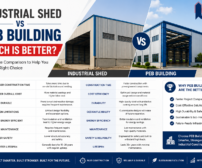
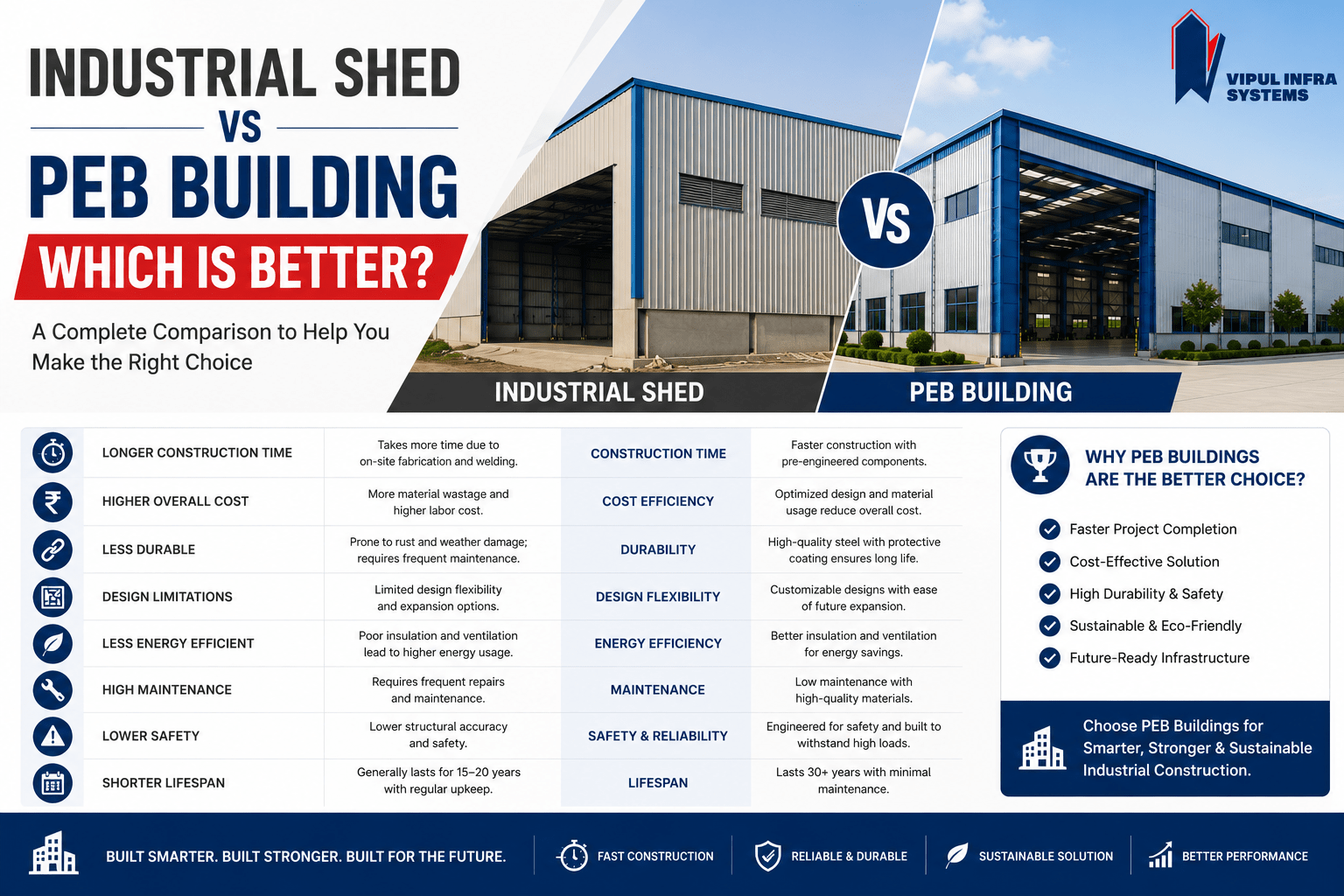
Industrial Shed vs PEB: Key Differences
| Parameter | Traditional Industrial Shed | PEB Building |
|---|---|---|
| Design Process | Manual, site-based calculations | Software-optimized, factory-engineered |
| Construction Time | 4 to 8 months on average | 30 to 50 percent faster, often 6 to 12 weeks |
| Steel Usage | Higher, less optimized | Lower, load-optimized sections |
| Cost per Sq Ft | Lower upfront, higher over time due to maintenance | Slightly higher upfront, lower lifetime cost |
| Clear Span | Limited, more intermediate columns needed | Wide clear spans up to 90 meters or more |
| Quality Control | Site-dependent, variable | Factory-controlled, consistent |
| Wind and Seismic Resistance | Depends heavily on site execution | Engineered for specific load codes |
| Maintenance | Higher, prone to rust and leakage over time | Lower, with better coatings and detailing |
| Future Expansion | Difficult, needs structural rework | Easier, designed with expansion bays in mind |
| Aesthetics | Basic, functional look | Modern, customizable facades and roofing |
Cost Comparison: Industrial Shed vs PEB
On paper, a traditional industrial shed may look cheaper because the upfront material and labor cost can be lower for very small structures. However, this comparison changes significantly once you factor in the full project lifecycle.
Construction Cost
PEBs reduce steel tonnage through optimized design, which lowers material cost despite the precision manufacturing process. Labor cost is also lower because PEB sites need fewer workers for a shorter duration, since most components arrive ready to bolt together.
Time Cost
Faster construction means your facility starts generating revenue sooner. A shed that takes 6 months to build delays your operations by 6 months, while a comparable PEB structure can often be operational in 6 to 10 weeks.
Maintenance Cost
Traditional sheds are more prone to corrosion, leakage, and structural fatigue over years of use, especially in industrial environments with chemical exposure or coastal humidity. PEBs use better coatings and detailing, which reduces long-term maintenance spending.
Strength and Durability
PEB structures are designed using internationally recognized codes such as MBMA and IS 800, with load calculations specific to wind speed, seismic zone, and snow load for the exact project location. This makes PEBs highly predictable in terms of structural performance.
Traditional sheds depend heavily on the skill and judgment of the local fabricator. Without standardized design software, there is more room for human error, which can affect the structure's ability to withstand extreme weather events.
Speed of Construction
This is one of the biggest differentiators. Because PEB components are manufactured off-site in a factory while foundation work happens simultaneously on-site, the overall project timeline shrinks dramatically. Traditional sheds follow a sequential process, where fabrication often cannot begin until the foundation is complete, which adds weeks or months to the schedule.
Flexibility and Future Expansion
PEBs are typically designed with future expansion in mind. Adding a bay to extend the building length is straightforward because the original design already accounts for modular extension. Industrial sheds, on the other hand, often require additional structural assessment and rework before any extension can be safely added.
When Should You Choose a Traditional Industrial Shed?
- The structure is very small and temporary in nature
- The budget is extremely limited and long-term use is not a priority
- Local fabrication resources are abundant and PEB transport logistics are difficult
- The project does not require wide clear spans or heavy load capacity
When Should You Choose a PEB Building?
- You need a warehouse, factory, or large storage facility
- Construction speed is critical to your business timeline
- You want consistent quality with factory-grade fabrication
- The site faces high wind, seismic activity, or heavy snow loads
- You are planning future expansion of the facility
For most commercial and industrial applications today, including warehouses, manufacturing plants, cold storage units, and logistics hubs, PEB is the stronger long-term choice. If your current requirement is smaller in scale, our Industrial Sheds solutions can also be customized to match your budget and timeline without compromising on basic structural quality.
Not Sure Which Structure Fits Your Project?
Get a free, no-obligation quote from our engineering team and compare costs for your exact requirement.
Get Free QuoteFrequently Asked Questions
Is PEB cheaper than a traditional industrial shed?
PEB is usually more cost-effective over the building's lifetime due to optimized steel usage, faster construction, and lower maintenance, even though the upfront quote may sometimes be slightly higher than a basic shed.
How much faster is PEB construction compared to a shed?
PEB construction is typically 30 to 50 percent faster than conventional shed construction because components are pre-fabricated in a factory and assembled on-site with minimal welding.
Can a PEB building be expanded later?
Yes. PEB structures are usually designed with modular bays, which makes future expansion easier and more cost-effective compared to extending a traditional shed.
Which option is better for a warehouse?
PEB is generally the better choice for warehouses because it offers wide clear spans, faster construction, and stronger load performance suited to large storage operations.
Are industrial sheds still used in India?
Yes, traditional sheds are still used for small workshops, basic godowns, and short-term structures where budget constraints outweigh the need for speed or wide clear spans.
Final Verdict
Both industrial sheds and PEB buildings have their place in industrial construction, but for nearly every modern project involving warehouses, factories, or large-scale storage, PEB stands out as the more efficient, durable, and future-ready option. The combination of speed, optimized cost, and engineering precision makes PEB the preferred choice for businesses that want to scale without structural limitations.
If you are evaluating your options, our team at Vipul Infra Systems can review your site details and recommend the right structure along with a transparent cost estimate.
Plan Your Industrial Structure With Confidence
Talk to our experts and get a free quote tailored to your site and budget.
Get Free Quote