


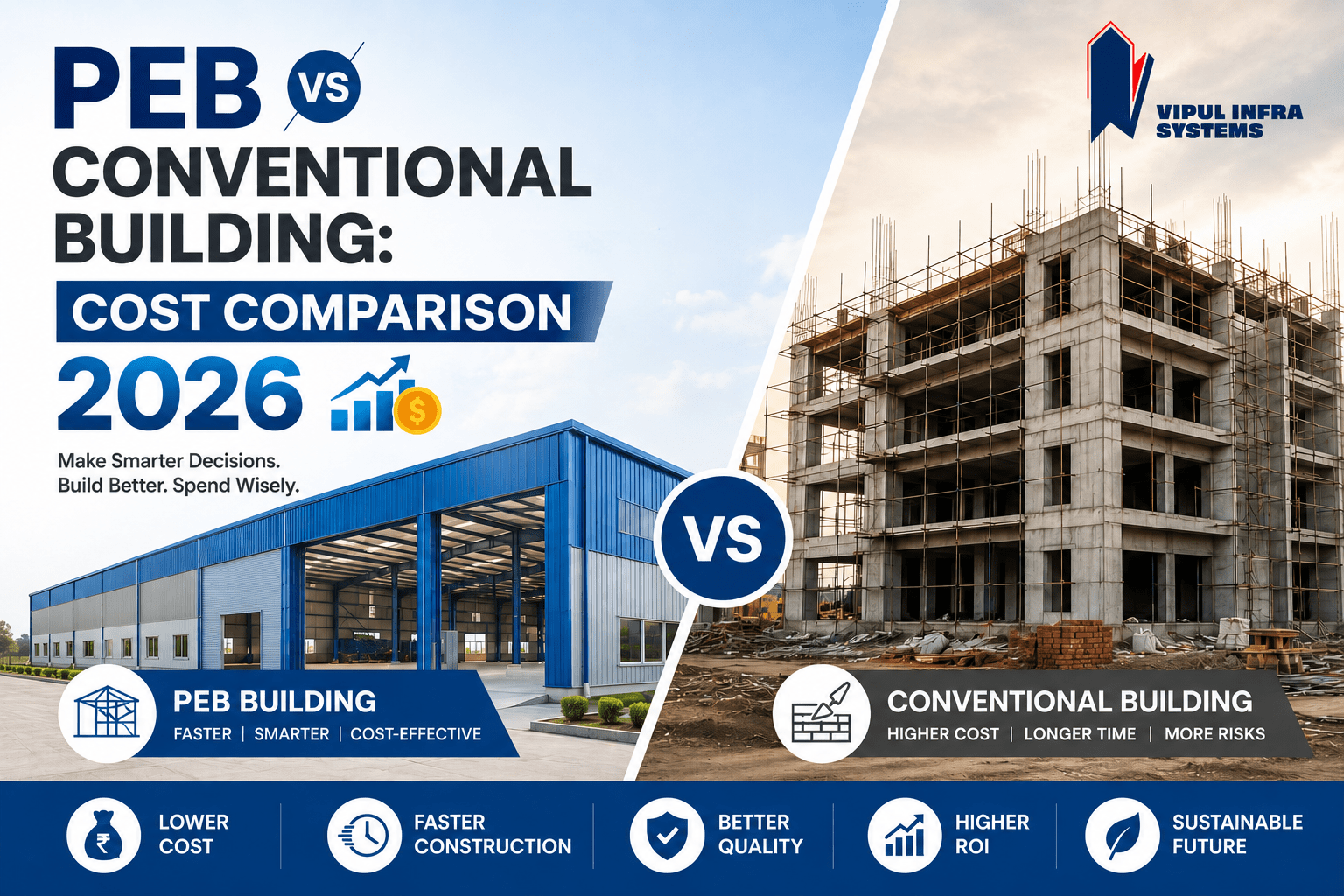
PEB vs Conventional Building: Cost Comparison 2026
Building a warehouse, factory, or commercial facility? The biggest decision you'll make isn't the location — it's the construction method. Pre-Engineered Buildings (PEB) and conventional construction each carry very different price tags, timelines, and long-term implications. Here's what the numbers actually look like in 2026.
What is a Pre-Engineered Building?
A Pre-Engineered Building (PEB) is a structural steel system designed, fabricated, and supplied by a manufacturer — entirely in a factory — before being bolted together on site. Every component (columns, rafters, roof panels, wall cladding) is precision-cut and ready to assemble, much like a giant flat-pack structure.
Table of Contents
Side-by-side cost breakdown
The table below compares a typical 10,000 sq ft industrial/commercial facility using both methods, based on 2025 market rates in India:
| COST FACTOR | PEB | CONVENTIONAL RCC |
|---|---|---|
| Material cost (per sq ft) | ₹800 – ₹1,100 | ₹1,200 – ₹1,800 |
| Construction time | 6 – 12 weeks | 6 – 18 months |
| Labour requirement | Low (bolt-together) | High (skilled trades) |
| Foundation cost | 25–35% less | Full RCC foundation |
| Maintenance (annual) | Low | Moderate to high |
| Expandability | Easy (modular) | Difficult, costly |
| Resale / relocation | Structure can be moved | Permanent, no relocation |
Why PEB costs less — and builds faster
"A 10,000 sq ft PEB warehouse can be ready for operations in as little as 8 weeks. The equivalent RCC structure typically takes 9–12 months."
Where conventional buildings still win
Total cost of ownership over 20 years
Upfront savings are one part of the picture. Over a 20-year period, PEB structures typically show lower total cost of ownership due to reduced maintenance (galvanised or coated steel panels resist corrosion), lower energy bills if insulated panels are used, and the option to expand incrementally without demolition.
Making the right choice for your project
Frequently Asked Questions
Which is more cost-effective in 2026: PEB or conventional buildings?
PEB buildings are generally more cost-effective due to faster construction, reduced labor costs, and optimized material usage compared to conventional structures.
Why are PEB buildings faster to construct?
PEB structures are pre-engineered and factory-fabricated, which minimizes on-site work and significantly reduces project completion time.
Are PEB buildings durable for long-term use?
Yes, modern PEB structures are highly durable, corrosion-resistant, and designed to withstand harsh weather conditions with low maintenance needs.
Ready to see what a PEB solution costs for your specific project? Get a detailed, no-obligation estimate tailored to your site, span, and load requirements.